
Conversation with Julien Delagrange
Artist and Founder of Contemporary Art Issue
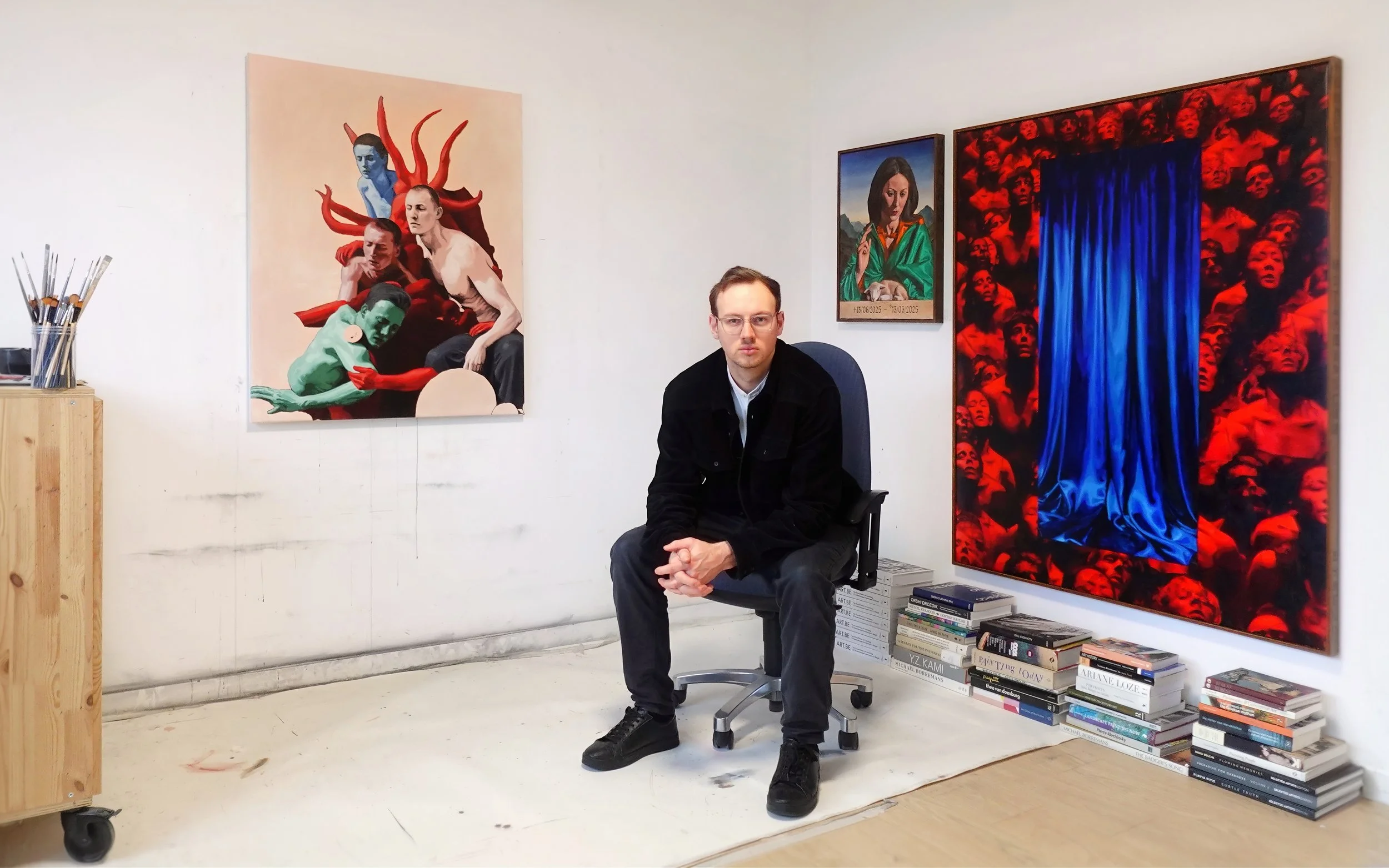
Julien Delagrange in his studio in Harelbeke, Belgium (2024). Photo by Trish De Buyser.
Julien Delagrange is an artist, art historian, and founder of Contemporary Art Issue (CAI). He is best known for oil paintings and charcoal drawings that hold a strong psychological presence. He has exhibited in solo and group shows in Germany, Belgium, the United Kingdom, and France. In addition to establishing the contemporary art platform CAI, Julien is also a prolific writer who has contributed to numerous publications. His most recent book ART.BE (2025), published by Borgerhoff & Lamberigts/MER. Books, provides an overview of Belgium contemporary art through the works of 151 artists.
In this interview, we take a deep dive into Julien’s multi-faceted practice. He unpacks how his background as an art historian informs his work across painting and writing. Julien also shares his insights on Artificial Intelligence (AI), art criticism, and the roles that an artist can play today.
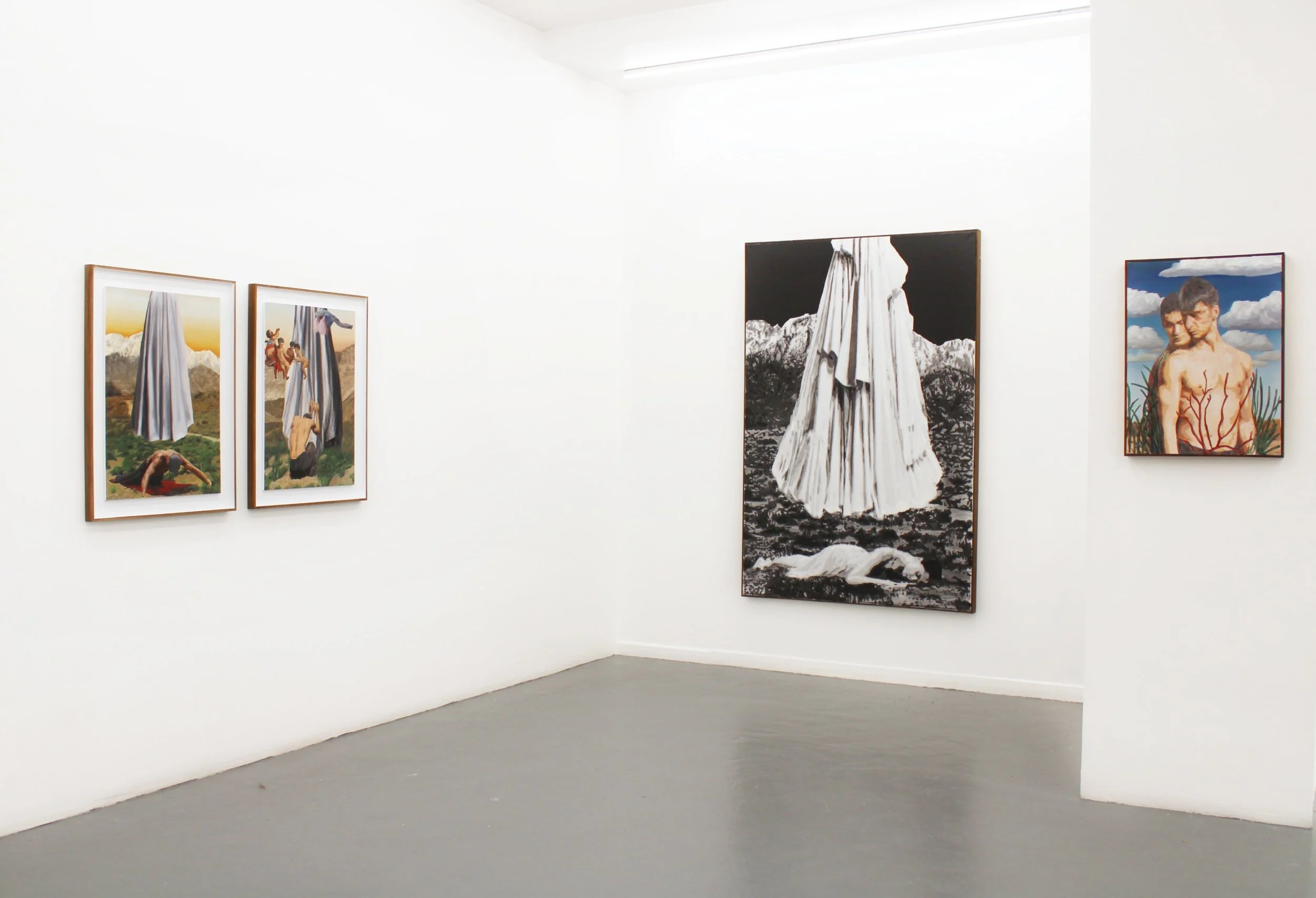
Julien Delagrange, Forgotten Rites, 2024, exhibition view at Galerie Sabine Bayasli, Paris, France.
You were trained as an art historian. How do you think it influenced your outlook towards artistic practice?
Being trained as an art historian gives one a heightened historical sensitivity, but also a strong urge to understand what is happening in the present. I was taught to think about art in terms of macro structures, and that way of looking at the past naturally extends to how I observe the contemporary art world. On the other hand, it also gave me a solid frame of reference to rely on. For instance, when I am developing an idea, contemplating a series, or trying to visualise a specific image, art-historical references almost inevitably surface. They are not always consciously quoted, but rather internalised to the point that they function as tools: compositional strategies, motifs, iconographic stepping stones, or ways of organising an image. In that sense, art history becomes an active resource rather than a passive archive.
Being trained as an art historian is also a strong preparation for becoming an art critic. While I sometimes engage in criticism in a more traditional sense through writing, I also see my painting and drawing practice as a form of art criticism. That self-conscious, critical attitude is very much inherited from the legacy of conceptual art over the past decades. It is something I consciously embrace. I am drawn to art that reflects on its own conditions—art about art. For instance, I cannot help but be critical of how certain styles, historical artworks, or motifs are often used purely for their visual effect, while their meaning and content are ignored or flattened, and risk being lost altogether. We live in a moment where virtually all styles, materials, and disciplines are available. However, throwing them into a visual blender driven by aesthetics or market logic does not feel right.
That said, being trained as an art historian also has its limitations. Sometimes, I envy artists who come straight out of an art academy, work with strong mentors, already have a mature artistic language before turning 25, and have a network of fellow artists in place. It is safe to say that it took me more time to arrive at a confident artistic practice, and the same can be said for building a peer network. That development was slower and more indirect. But everyone has their own trajectory, and I appreciate the path I have taken and would not change it.
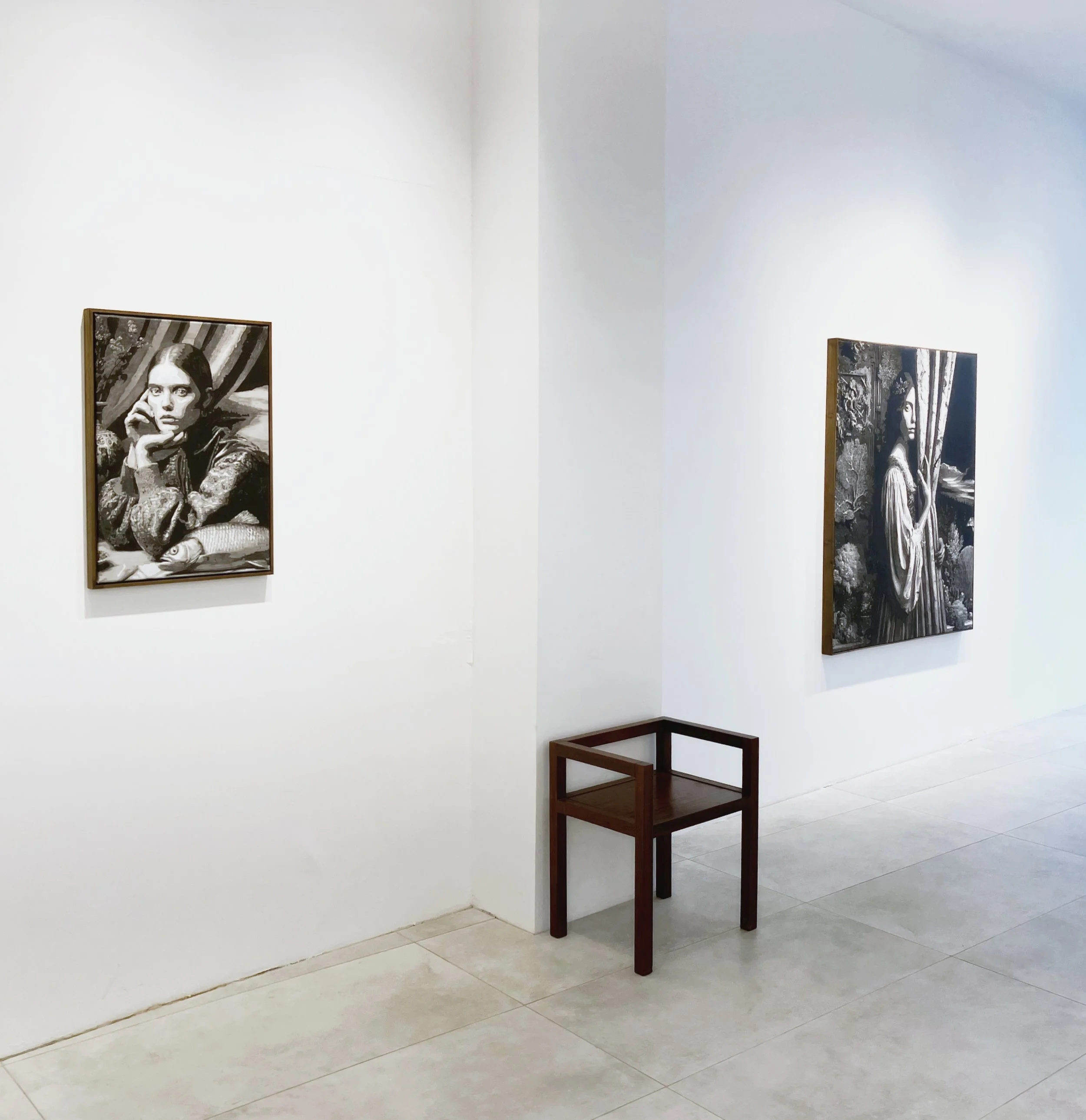
Julien Delagrange, Artificial Empathy, 2024-2025, exhibition view at Space60, Antwerp, Belgium.
In your solo exhibition Artificial Empathy (2024-2025) at Space60 in Antwerp, you presented a suite of 12 charcoal drawings on linen and paper titled Forbidden Productions. It builds upon the preceding Forbidden Reproductions and Forbidden Collages which question the problematic nature of artistic appropriation and creativity in the 21st century. Could you briefly talk about your interest in this topic?
This question connects closely to the previous one. The different Forbidden series emerged directly from my observations of how fraught artistic appropriation has become today. Historically, appropriation functioned in a relatively transparent way. Artists reused existing images while clearly acknowledging their source, often to produce satire, critique, or pastiche, such asAi Weiwei with Han Dynasty Urn with Coca-Cola Logo (1993) or Andy Warhol with Campbell’s Soup Cans (1962). In these cases, the reference was legible, and the act of appropriation itself was the core of the work.
Today, however, especially with the rise of the internet, that clarity has largely disappeared. Many artists now rely on online image platforms as an almost automatic starting point, not because they have a clearly defined idea they want to develop, but because scrolling through reference images is the quickest way to arrive at something that “works” visually. These images are then translated into paintings or other artworks without proper attribution, while still being presented as entirely original. In that context, appropriation becomes deeply problematic.
With the Forbidden series, I intentionally adopted the same strategies, but did so transparently. By making the process explicit, I aimed to expose, subvert, and critically play with these dominant modes of image making.

Julien Delagrange, Dark Matter, 2022, exhibition view at Space60, Antwerp, Belgium.
Following up on the previous question, how has this inquiry unfolded across the different series?
With Forbidden Reproductions, I began from a mental image for a painting and then searched the internet for an existing image that came as close as possible to that imagined composition. What was striking, and frankly unsettling, was how often such an image already existed, sometimes with an uncanny level of precision. This led to a fundamental question: how can we still speak of originality when images seem to pre-exist our intentions, even when we are not consciously aware of them?
Forbidden Collages addressed a related strategy. Collage, particularly between 2000 and 2015, became an almost omnipresent method in contemporary painting: artists gathered reference material and recombined it into new compositions. While this approach can be more defensible, it still carries similar ethical and conceptual risks. The title of the work The Coronation (after unknown pin, DM for credit or removal) (2023), for example, is a tongue-in-cheek reference to how copyright is often handled on social media. It points to a broader cultural tendency to use material that is not one’s own while deflecting responsibility through vague disclaimers. That lack of accountability, I believe, has also seeped into artistic practice.
Artificial Empathy extends this inquiry into the realm of artificial intelligence. With the democratisation of AI image generation through platforms such as Midjourney, DALL·E, and Stable Diffusion, the situation became even more complex. Not only do existing images appear endlessly recyclable, technology can recycle it for the user and present it as new and original. Combined with the tendency to blend styles indiscriminately, this raises a new set of urgent questions.
In this series, I set out to address those questions by critically testing the limits of AI image generation, without succumbing to either technophobia or blind optimism. One key takeaway was that AI still struggles with ambiguity, contradiction, and layered meaning. It tends to resolve images too quickly, privileging a single interpretation over others. This is precisely where art distinguishes itself: the ability to sustain tension, ambivalence, and multiple readings within a single image remains deeply human. In the end, AI is simply another tool, another form of software, that artists can choose to add to their toolbox, or not.

Julien Delagrange, The Passion (7) (after Pina Bausch), 2020, charcoal on paper, 100 x 70cm. Private collection. Image courtesy of the artist © Julien Delagrange.
In your body of work, what is one important piece or project that unlocked a new approach or direction in your practice?
I think that would have to be the Passion series (2019-2021). In that body of work, I developed my rather unorthodox technique with charcoal, and discovered my artistic vision, particularly my interest in approaching the human condition from a more anthropological perspective. Interestingly, the main reference for that series did not come from visual art history, but from dance and performance, specifically Pina Bausch’s Rite of Spring. Encountering that work had a deeply eye-opening impact on me. What the Passion series revealed to me was a confrontation with what we fundamentally are: our primitive nature, something we tend to forget or suppress in a civilised, secular, globalised, and highly technological world. Yet it is precisely that suppression that often explains why we struggle, why I struggle. There is an almost violent, primal force within us, present in every individual, that no longer seems to fit comfortably within contemporary life. That internal conflict between instinct and society continues to fascinate me, because it resurfaces again and again in different forms.
At the same time, I feel that we are lacking new mechanisms or belief systems to cope with the challenges of a rapidly changing world. We continue to experience an almost irrational longing for beauty, the sublime, existential meaning, and even transcendence, yet many of the traditional structures that once addressed these needs have eroded. Religion and spirituality are the most obvious examples. In their place, we increasingly privilege reason and science over emotion and instinct. Reason is presented as the primary path to truth, while our natural urges are often dismissed as irrational or illusory. For a long time, I followed that logic myself. Reason was extremely important to me, and I tended to see it as the solution to almost everything in life. Rational frameworks can explain nearly anything. For instance, the love one feels for a life partner, which can be reduced to biological processes to stimulate reproduction and survival from an evolutionary perspective. But such explanations do not make that experience any less real or powerful. That love is truth. That love contains real power.
The same applies to how we deal with loss. Funerary rituals and religious narratives have historically offered ways to cope with grief. From a strictly rational standpoint, these practices may appear irrational, yet they are profoundly effective in helping people process absence, memory, and longing. This may explain why we practice religion and spirituality from an evolutionary perspective. But even if God is declared dead, those needs do not disappear. I am not a religious person, but the internal conflicts that emerge are affecting us.
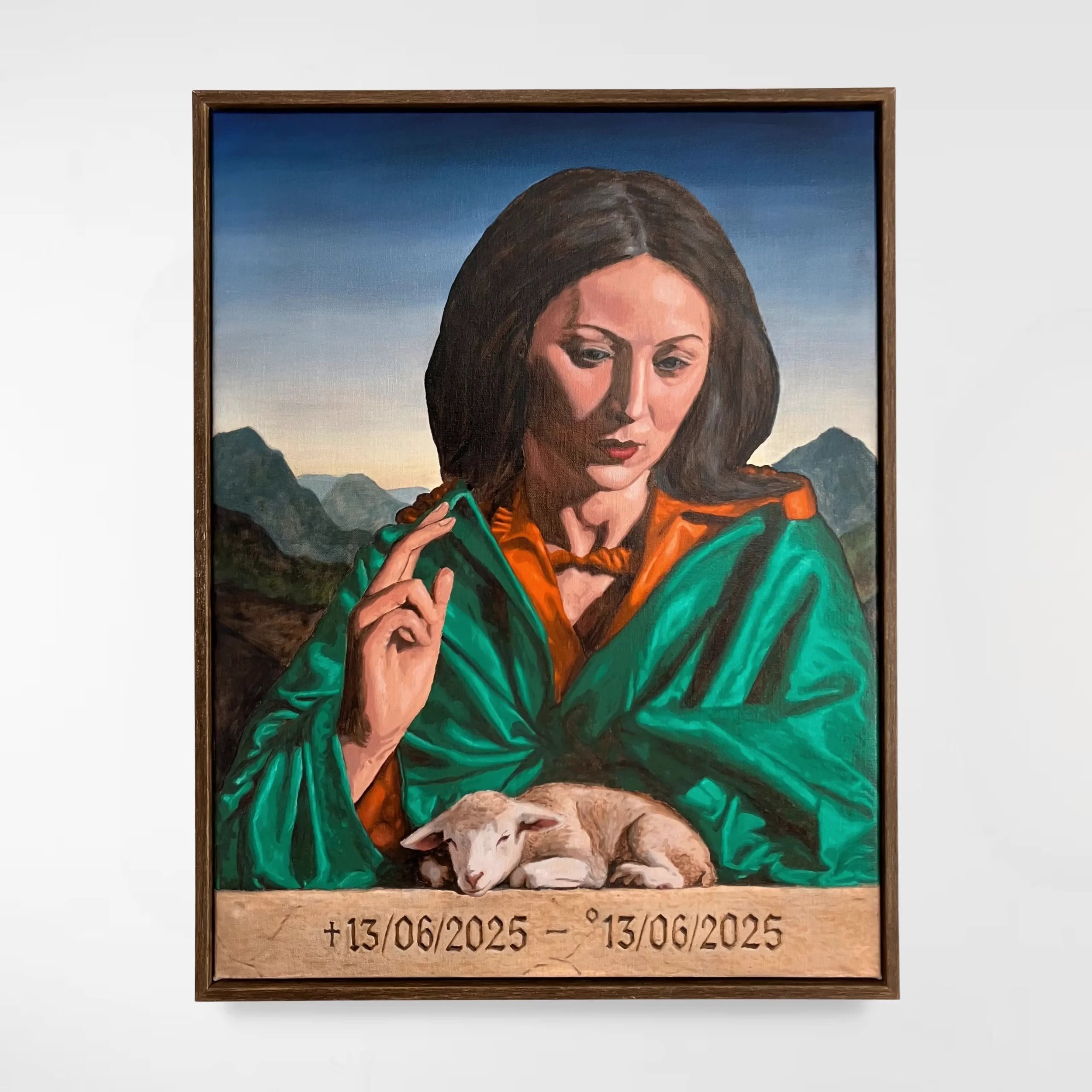
Julien Delagrange, Ik Zegen Uw Dood, Mijn Zoon (I Bless Thy Death, My Son), 2025, oil on linen, artist frame with painted inscriptions, 65 x 50 x 5cm. Collection of the artist. Image courtesy of the artist © Julien Delagrange.
Could you elaborate on that?
A very personal experience last year made this tension painfully clear. We were expecting a son, and because of advanced medical technology, we were confronted with the statistical likelihood that something might be seriously wrong. Suddenly, we found ourselves in an absurd and devastating situation where primitive instinct and unconditional love collided with rational calculation and technological knowledge. Reason suggested one course of action; everything else in us resists it.
During that period, I created a painting titled I Bless Thy Death, My Son (2025). It was something I never expected myself to do, but it is an approach I have gradually come to embrace. The painting depicts a female figure making a blessing gesture. That gesture is derived from the figure of John the Baptist in Van Eyck’s Ghent Altarpiece (1426-1434) blessing a cup of poison: the poison that, in this case, we as parents were forced to bless. Below her is a small lamb, representing my son. It is deliberately depicted as extremely small, even for a newborn lamb, reflecting a life that never fully entered the world. The lamb also refers to Agnus Dei (1635-1640) by Zurbarán, and by extension to the iconography of the Father, the Son, sacrifice, and resurrection. This painting helped visualised my complex experience in all its ambiguity. It became a way to cope with personal loss, while simultaneously addressing a deep internal conflict. It shows how the personal, the historical, and the conceptual converge within a single work, and how art can serve as a space where these layers are held together rather than resolved.
It is precisely in these moments, internal conflicts, ethical and emotional deadlocks, that art becomes meaningful to me. Art is one of the only spaces left in this world where one can find solace, reconciliation, something spiritual, and sublime. It allows us to reconnect our primitive nature with the realities of contemporary life. That realisation first crystallised for me in the Passion series, and it continues to drive my practice today.
It shows how the personal, the historical, and the conceptual converge within a single work, and how art can serve as a space where these layers are held together rather than resolved.
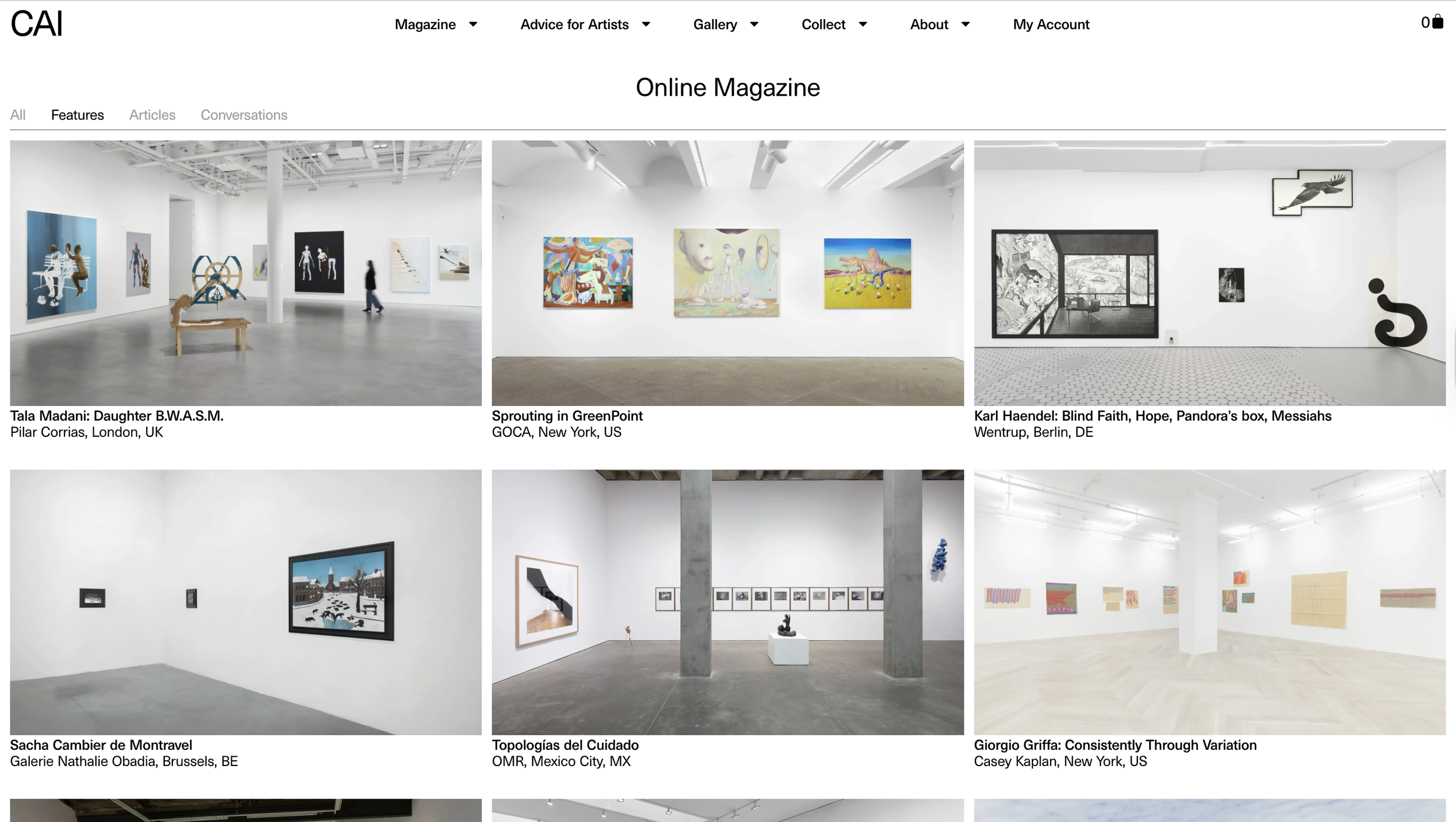
Screenshot of contemporaryartissue.com, which includes an online magazine.
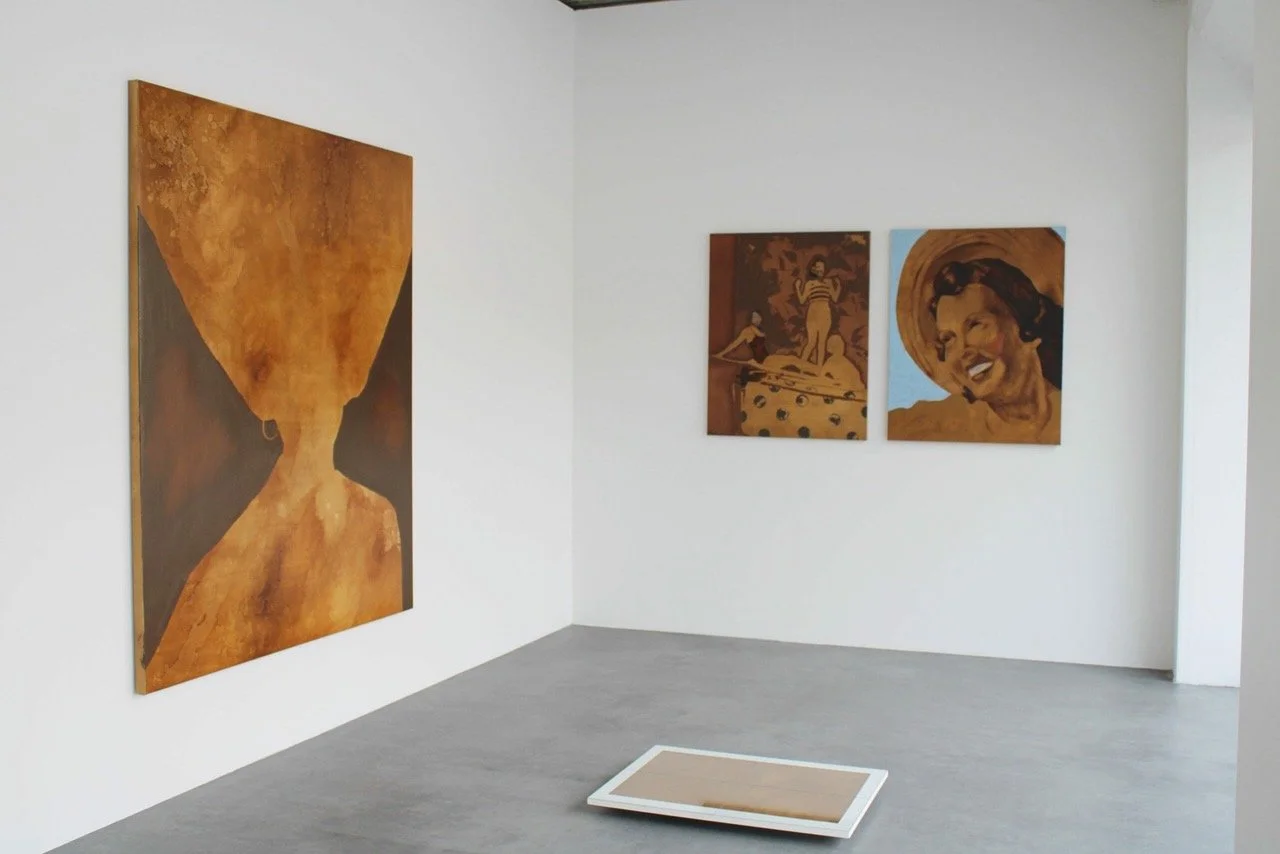
Installation view of Tonino Mattu: the Golden Days (2021) at CAI in Kortrijk, Belgium.
CAI comprises a magazine with digital channels on YouTube and Instagram, an exhibition programme where works are available for sale, and an advisory for artists. Did you set out establishing CAI with this structure in mind or did it evolve along the way?
It certainly evolved along the way. I strongly believe in serendipity, both in life and in entrepreneurship, and that applies equally to art. CAI started as an Instagram account. At the time, I simply wanted a space to continue discussing art beyond my professional activities in the art world and my own artistic practice. I began sharing artists I was interested in, and it became a personal process of discovery: a way of mapping what was happening in contemporary art. Quite quickly, it grew into a small community of people who were similarly looking for images and meaning: artists, collectors, enthusiasts, and galleries. At a certain point, I started to feel the limitations of social media as a format. It restricts how much context, depth, and writing I can share, so creating an online magazine felt like a natural next step. That is how contemporaryartissue.com, which is now the central platform, came into being.
From there, things continued to develop very organically. I felt the need to bring art into physical space as well, beyond the digital realm, which led me to curate exhibitions and make works available for sale. Around the same time, I became increasingly aware of shifts in how people consume content. Many preferred watching videos over reading long texts, so I started creating video versions of the articles I was writing. That gradually developed into the YouTube channel. Through YouTube, another layer emerged. I noticed a strong desire among artists not only to learn more about contemporary art, but also to better understand how the art world functions. That led me to create more content focused on the art ecosystem itself, which in turn generated a growing number of requests for personal advice. This is how the advisory for artists came about.
None of this was planned in advance. New projects tended to present themselves along the way, and the process became one of adapting and learning how to navigate those different waves. I never imagined that helping artists would become such a central part of what I do today. Yet, seeing how I can make a tangible difference has given the entire project a deeper sense of purpose.
New projects tended to present themselves along the way, and the process became one of adapting and learning how to navigate those different waves.
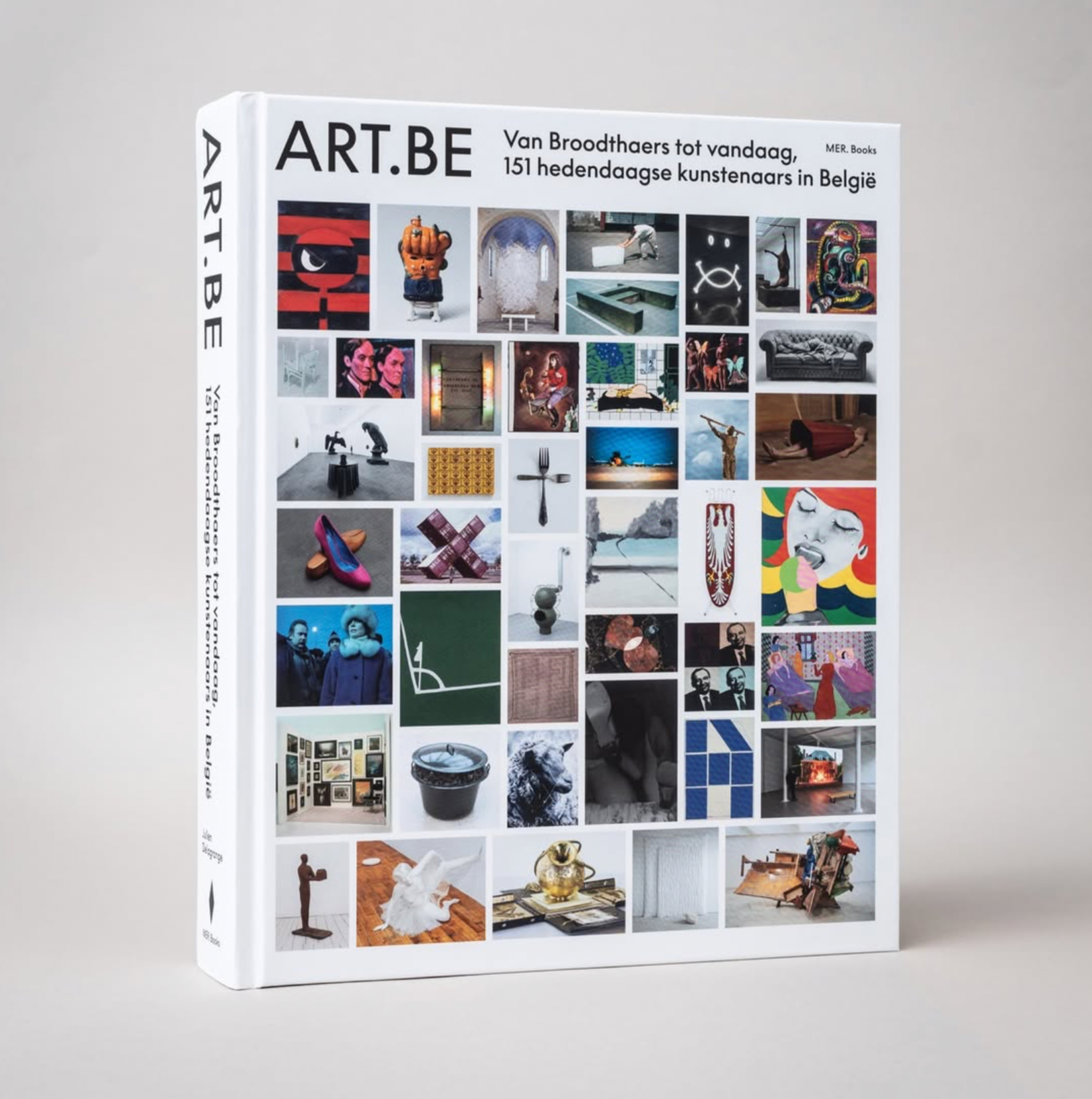
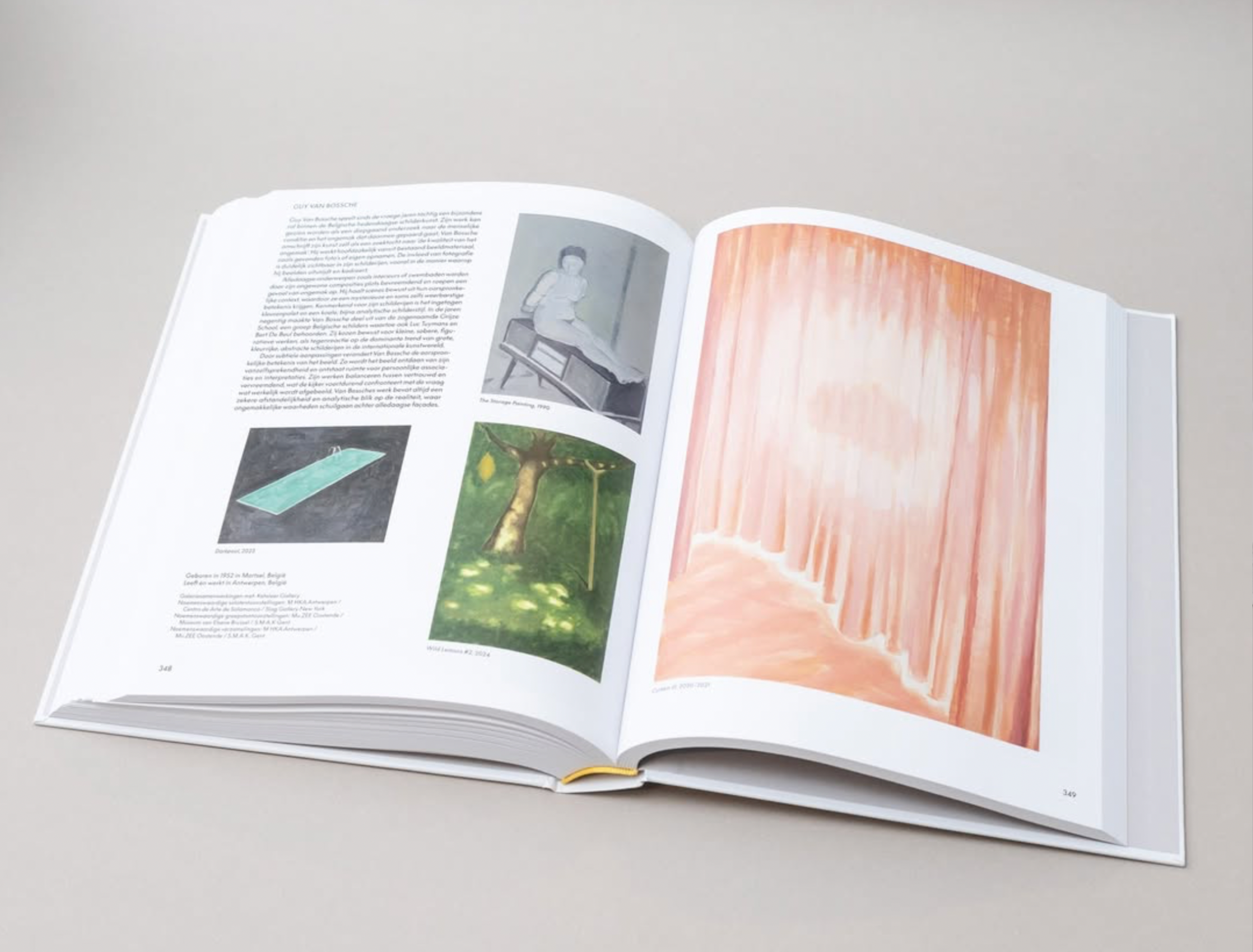
The book publication ART.BE by Julien Delagrange, published by Borgerhoff & Lamberigts/MER. Books.
You recently completed a major publication titled ART.BE (2025), which discusses 151 contemporary artists in Belgium. It is published by Borgerhoff & Lamberigts/MER. Books. How did this project come about? And what frameworks did you set up to guide the research and writing process?
This project also emerged through serendipity. The publisher, which is one of the leading art book publishers in Belgium, approached me after following my work on YouTube and reading my articles, and they were interested in developing a book together. What immediately connected us was our very own art scene here in Belgium. From there, the idea developed to create a publication that ties into the background of CAI as an online art platform operating within a new media landscape marked by the world wide web, viewing rooms, online magazines, and algorithms. That concept is also directly reflected in the title ART.BE and is interlaced throughout the publication. For instance, we included strategies such as the use of data and algorithms to analyse the Belgium art scene, while at the same time critically reflecting on those tools.
In that sense, the intention of the book closely aligns with the broader mission of CAI. It aims to discuss what is happening in contemporary art today, with a focus on Belgian contemporary art. It makes that conversation accessible to a wider audience while maintaining a sense of rigour. There are many people who are genuinely interested in art but find it difficult to navigate the field on their own. By presenting a snapshot of 151 contemporary artists in Belgium, the book brings a large amount of information together in one place, making the art landscape more approachable without oversimplifying it. In the introduction, I describe art as a feast, consisting of many different dishes: some are easy to consume, others more complex and demanding. Making art accessible does not mean only offering what is easy to digest and sweet. Nor does it mean the author must do all the chewing for the reader, which strips art of its depth. With ART.BE, the idea is simply to set the table. Readers are free to choose, to taste, to linger, and to explore further on their own terms.
What makes the book distinctive is that it goes beyond the usual suspects. From this perspective, the book is not a traditional overview publication. It tries to present an alternative approach, as an open anthology that does not aim to canonise an art scene by deciding who is important and who is not, but to present a snapshot of a living scene that goes beyond the scope of the book itself.
Making art accessible does not mean only offering what is easy to digest and sweet. Nor does it mean the author must do all the chewing for the reader, which strips art of its depth.
Could you share one or two learnings from working on ART.BE?
One learning was just how vast the Belgian art scene truly is. I was already aware of its richness, but working on the book made it clear that the depth and overall quality exceeded what I had anticipated. 151 artists sound substantial, and a 488-page book appears comprehensive. But in reality, the scope of the art scene cannot be captured within a single volume. I arrived at a humbling realisation: it is almost impossible to know everyone. While assembling the book, there were several artists I had not encountered before, or only knew their name but not their work. That experience reinforced the importance of opting for a broad and open overview, not only for newcomers, but also for people who are already familiar with the Belgian art scene.
Another important insight relates to how the artists are presented. There is no hierarchy in the book. Those international superstar artists are placed alongside the other artists, without visual or textual distinction. This makes the experience of moving through the book particularly engaging, because one cannot immediately tell who has an internationally established career and who is primarily known within a national context, without knowing them prior or looking at the résumé section. What becomes evident through this structure is that there is no corresponding dip in quality. International visibility reveals itself as relative rather than absolute, and certainly not as a conclusively reliable measure of artistic merit.
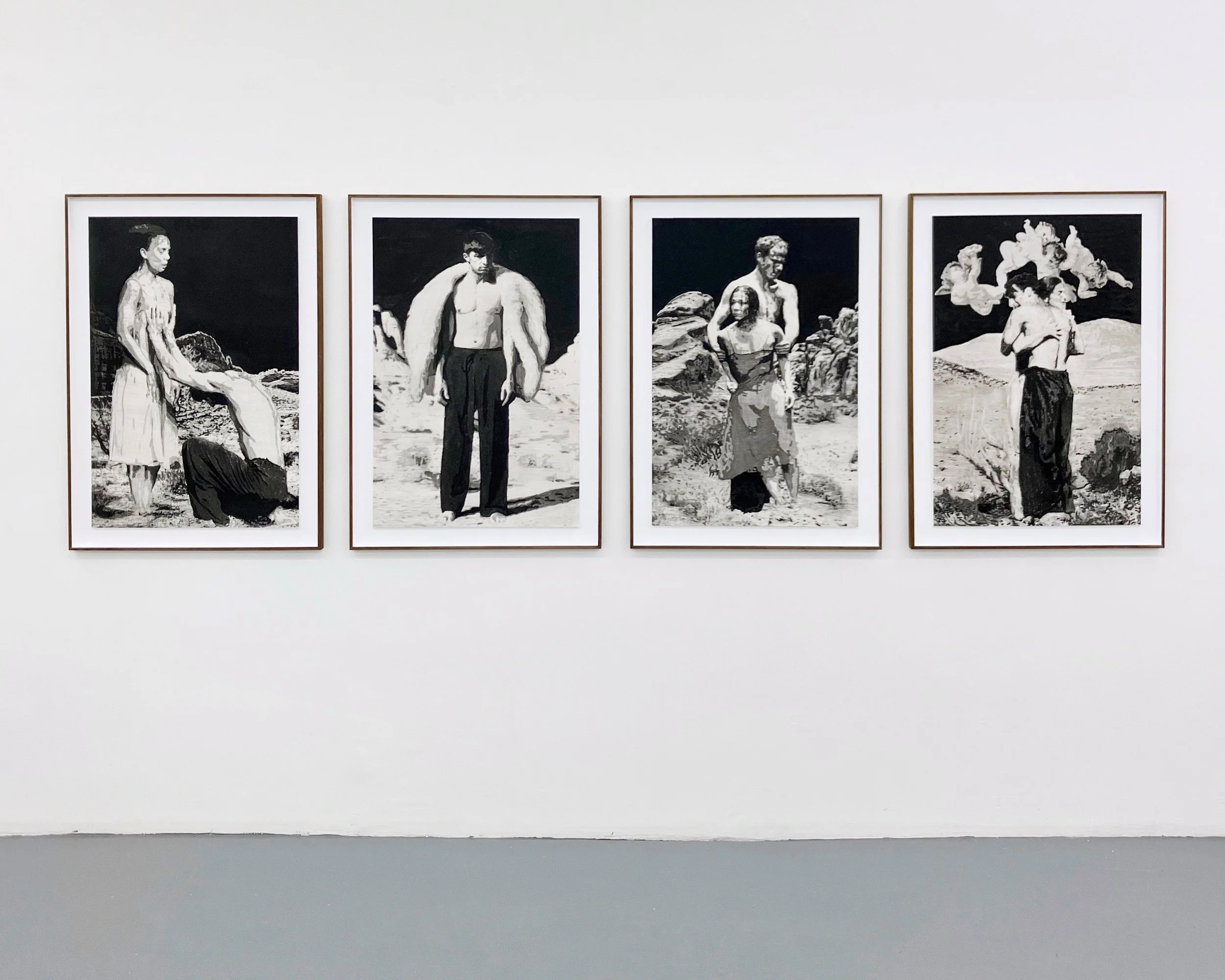
Julien Delagrange, Forgotten Rites, 2024, exhibition view at Galerie Sabine Bayasli, Paris, France.
In this video from Artistics.com, you said “I believe it is very empowering for an art critic to work in painting and drawing. And, the other way around, as an artist, it is very healthy to not only write about your own art but also art in general, because you are continuously re-evaluating your vision and opinion…” What values or motivations guide your engagement with art criticism, as a writer and reader?
In the moment, the many fleeting thoughts often all seem equally valuable and interesting. Some of them come and go, while others return more frequently and gradually gain more weight. Much of that thinking happens intuitively or subconsciously, especially in the studio. Simply through the act of writing about it, that vague understanding can turn into something much clearer. There is real power in that process. This is also why I am somewhat concerned about the increasing use of AI-generated text, particularly for artist statements. I am afraid that this heightened intensity of engaging with your own thoughts may disappear, and that people will no longer fully work through their ideas or their practices. Tools like ChatGPT can certainly be useful, for correcting errors or refining phrasing, but the thinking itself should not be outsourced. One needs to digest those ideas, give them time and attention, and allow them to grow.
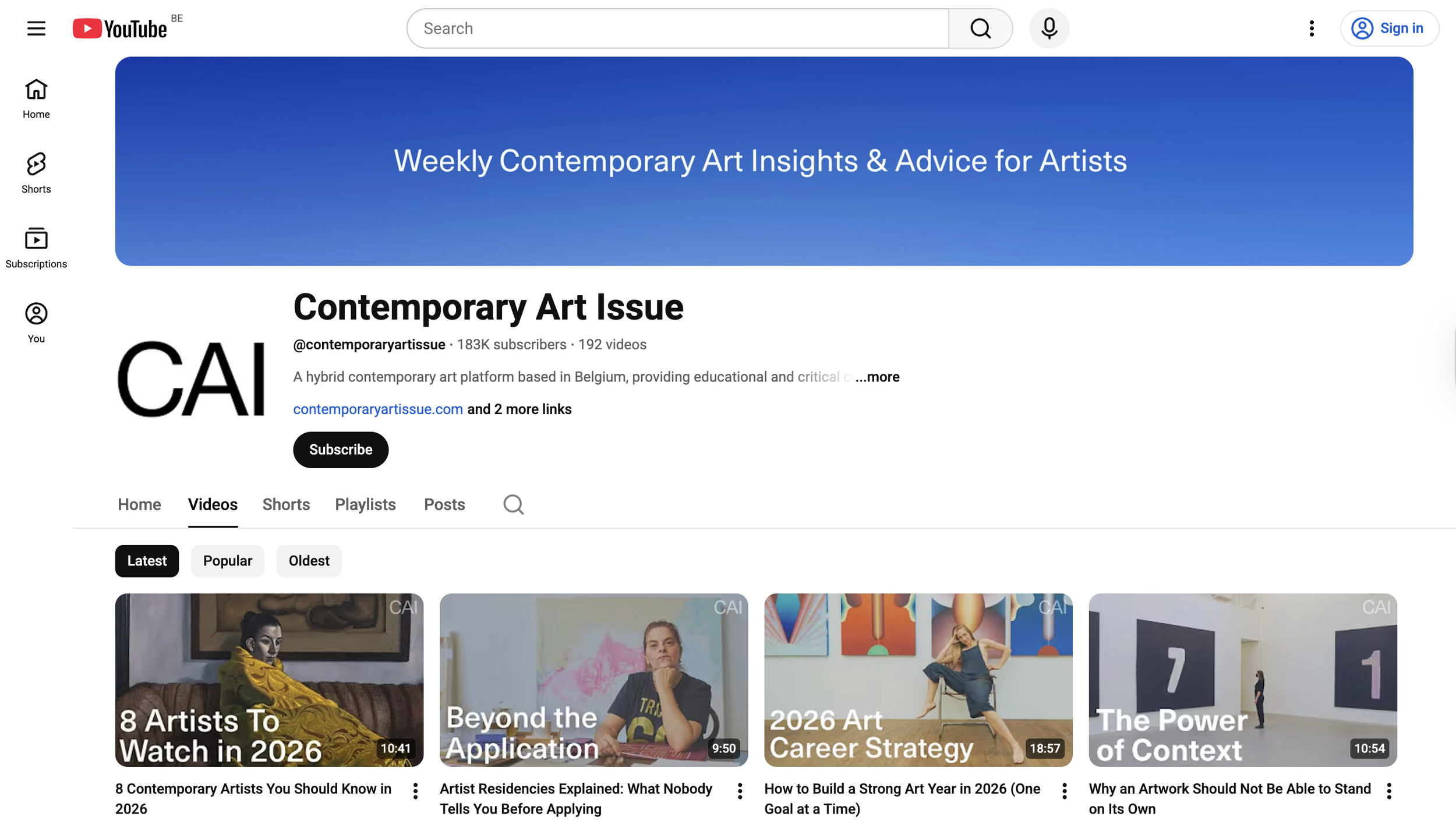
Screenshot of the Contemporary Art Issue YouTube channel @contemporaryartissue.
On CAI, you have often spoken about artists having a day job to sustain them through periods of uncertainty. How do you navigate splitting time between your artistic practice and your work at CAI? What arrangements (or compromises) have worked out well for you?
I think that because of the success of CAI, but also because of the genuine joy I experience in working on its projects, whether that is writing an article or doing a studio visit, I have not spent as much time in the studio as I would ideally want to, especially over the past year. In particular, the book project consumed a significant amount of my time. I suspect this is something many artists can relate to. However, what helps enormously is that I am dealing with art on a daily basis. Rather than draining my creative energy, this fuels it. Writing, researching, visiting exhibitions, and engaging with other artists constantly generates new ideas and thoughts. I can clearly see how that feeds directly back into my own work and pushes it forward.
There are different ways artists can relate to a day job. Some arrangements require one to switch off creatively during the day and then switch everything back on after one enters the studio, ideally with a fully recharged battery. In my case, that switch is never really turned off. The creative process runs continuously, and that ongoing engagement creates the excitement and urgency I need to return to the studio. That is what has worked well for me. It makes the time I do have in the studio incredibly valuable, because it remains the place where everything comes together. It is still what I love most but interestingly, I also experience my work at CAI very clearly as a form of self-development. In that sense, the two do not cancel each other out; they reinforce one another.
As someone who wears multiple hats and engages in the art ecosystem in different ways, how do you think about the role(s) of an artist?
I think this is a very interesting topic, because for a long time the artist seemed to be expected to be only an artist. There was a kind of tacit separation of roles, a sense that you had to stay in your lane. Sois belle et tais-toi (be beautiful and shut up). That idea is increasingly being questioned, and I find that shift both necessary and encouraging.
What I find particularly engaging is how more artists are now taking responsibility for their own texts, participating more actively in panel discussions, and thinking critically about how the art world functions. Some artists are no longer content with simply operating within existing structures, but are actively trying to improve or rethink them. Brooklyn-based artist Ajay Kurian and his initiative NewCrits are a good example of this, which provides affordable arts education, led by artists. Rather than staying within a prescribed role, he opened up a new lane altogether, offering an alternative model that contributes meaningfully to the ecosystem, to many artists, and art in general.
I think this reflects a broader shift. The art world is changing, and there is a clear generational transition underway. That creates an opportunity for artists to take on a more central and active role, not only as producers of work, but as contributors to the wider discourse and infrastructure. This is not something I set out to do consciously with CAI, but it is something I strongly believe in.
I would encourage artists not to hold back if they have an idea or a project that could make a difference. Being an artist should not automatically disqualify you from engaging more broadly, nor should it be seen as a conflict of roles. Of course, it is important to be aware of certain conventions within the art ecosystem, but if you genuinely feel you can contribute something valuable, then it is worth doing.
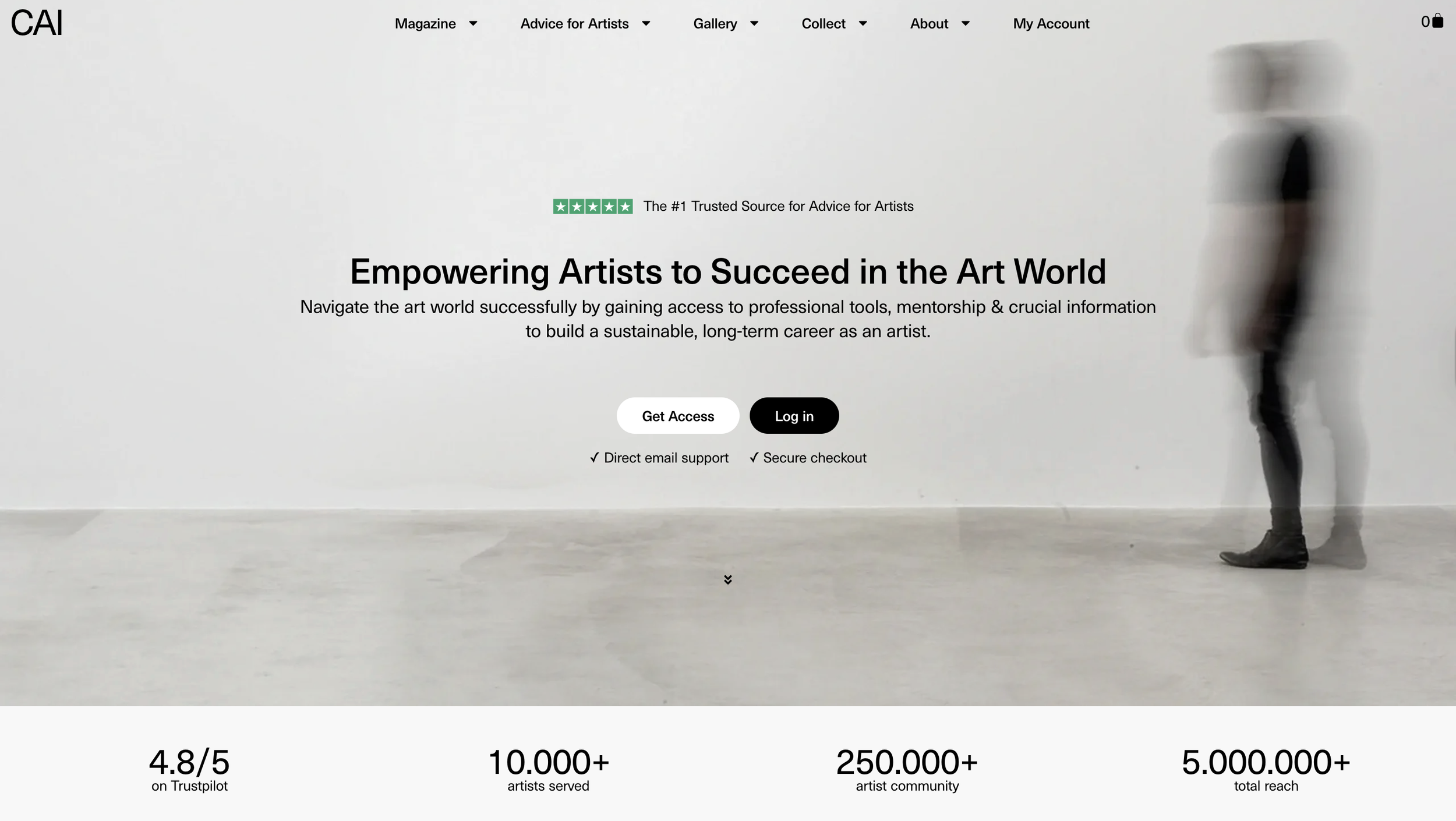
Screenshot of contemporaryartissue.com, a segment dedicated to industry-approved career advice for artists.
What is one advice you hold on to?
I would say: work hard and be generous. And by generosity, I mean being generous in a broader sense: toward the people around you, but also toward strangers. It is a humble way of moving through life, and it is something that tends to be deeply appreciated.
Generosity only really works if it is not transactional. One cannot give in order to receive something back. One has to give because one genuinely wants to. For me, that mindset has been very grounding. It creates a sense of integrity in what one does, because one knows one is giving one’s best—time, energy, attention—without calculation.
This is something I actively try to practice today by sharing as much knowledge as I can on www.contemporaryartissue.com and keeping the prices of the products and services I offer through the platform as accessible as I can. In the end, that choice feels more valuable to me.
Are there upcoming projects you wish to share?
If everything goes as planned, I will have two solo exhibitions in 2026. The first one is scheduled for April and will take place in my hometown of Harelbeke. In many ways, it feels like a homecoming, as I have never shown work there before. The venue itself is not a prestigious institution, but rather a small, humble space that regularly hosts exhibitions of all sorts. I value that a lot. After having done several international shows and more high-profile projects, it feels right to return to a very modest and grounded context, especially with a body of work that is particularly personal. Following that exhibition, I aim to complete the series later this year and present it in a solo show at my gallery in Paris, Galerie Sabine Bayasli. For those who are curious, I warmly invite them to follow along and see how the project continues to unfold.
This interview has been edited.